

Digital and AI: Engineering Performance
AI can transform the actual and perceived value of Digital in Engineering and Operations.
Whilst AI is undoubtedly heavily hyped, there are huge potential impacts for Engineering and Operations.
AI can increase the “drive” by surfacing performance insights from data that is too dirty, too big, too unstructured, too difficult to access to have been analysed in the past.
AI can automatically gather granular performance data of the Red Thread – reality.
AI can increase drive by building workflows in hours to automate tasks that whilst painful have never been able to justify a custom IT development – from securing a lay-down yard, gaining approval for an invoice, or replanning delivery scenarios.
AI can massively reduce the accidental friction that has been created over the years with onerous manual data collection, excessively complex compliance processes and weak infrastructure
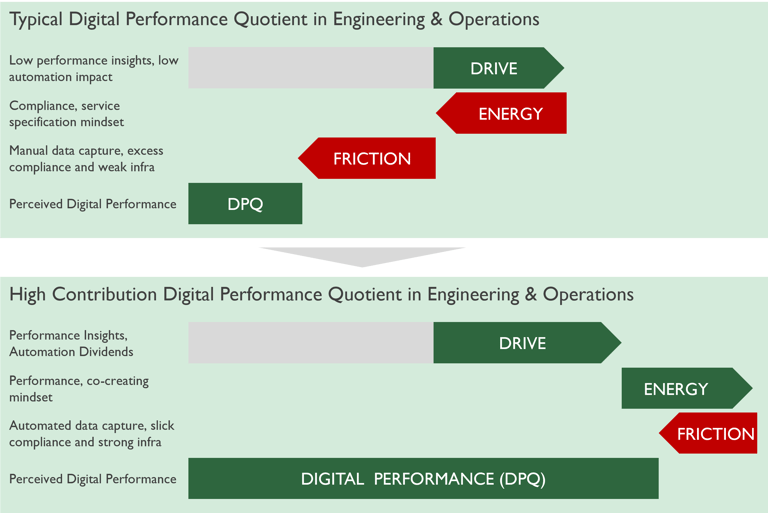
However, this potential is massively impacted by the “Energy” in the system – relationship between the office and the workface. In a high energy environment there is high discretionary effort and easy progress. Here AI can be the trigger for a reset, but it takes digital leaders to show the way.
The opportunity for Digital Leadership
Habit P3 – “Face Facts” of the EPH-12 underpins performance improvement. Today, the perceived digital performance quotient (DPQ) of most in-house digital department is much lower. Data is locked away and only data scientists in complex IT projects can get it. Automation projects have often been a central push without Engineering ownership and ended in rejection; or grey IT within Engineering that cannot scale.
Digital has a unique power – to mandate friction for everyone – often on behalf of someone else. The laptop approval process; the holiday approval; spend approval. Just like the tax collector collects taxes for the good of others – health and policing – it still has an opportunity to do so crisply, elegantly and efficiently. However, often processes were designed by people in offices, not workplaces and with a compliance not an efficiency mindset.
The hostility to the overheads can lead to a negative cycle – Operations see Digital as an overhead; Digital see Operations as unreasonable. Both sides point out their differences - “no-one ever died doing IT”, the lack of physical engineering experience, the lack of familiarity with digital tools a 5-year can use. The relationship becomes transactional and whilst participants point to the inputs, neither side owns the outputs.
Whilst AI can be the trigger, it is the leader who steps up to break this cycle.
A Strategy for Digital and AI in Engineering Operations
The arrival of AI does not mean starting from scratch; it is the "turbocharger" for the investments you have already made. This five step strategy assumes you have the secure infrastructure, networking and enterprise systems in place. We aren't here to replace the engine, but to really connect it to the wheels. By building on your existing data foundations and infrastructure plans, we can move beyond "keeping the lights on" to have a seat at the table and unlocking genuine performance.
Start with Energy and Shared Purpose. Whilst Digital and Engineering are undoubtedly different, they are both here with one interest – to deliver performance. Start with “Really listen” (E1), “Own Mistakes” (E5), “Be Open” (E2). It is very rare that time spent on-site amongst the teams that have to make it happen every day doesn’t help you stand in their shoes. Remote working for all its ease, rarely builds the human connection needed for powerful relationships. For digital leadership and delivery teams – they have to understand the problem they are trying to solve.
Own the Friction. Whilst digital may not own the processes, it is the “enforcer” of compliance, data collection and resource management. Ownership means proactively costing the non-tool time; the rest of the business is rarely aware of the cost of the steps they design into processes. Secondly, there are a set of levers that can be applied – not as a massive project, but as a backlog of incremental improvements. The traditional ones of “don’t do it” and “simplify” are now joined by AI powered alternatives. AI can create simple workflows to pre-populate documents (so the user doesn’t have to), AI can automatically clean / suggest data that previously would have caused a rejection e.g. “You asked for a DN30 PN16 Gate valve – did you mean a DN300 PN16 Gate Valve?”
Thirdly, deliver in joint teams. We call this “OpsTech” a team that is “bilingual” in both operations and technology. It doesn’t mean that everyone is fluent in both; but that a shared team has the competency and credibility with both Operations and Digital to work through a backlog of friction opportunities. Targeted on friction reduction, not feature delivery, they start small, second in operations and digital hi-potential talent who then go on to either form new teams, or return to their roles as digitally enabled, operationally literate leaders.
Finally, Own the Result (P5) – see the intervention through to the friction reduction with widespread adoption; not the delivery of the functionality.Give “them” access to “their” data. AI has an incredible ability to (i) manage dirty data and (ii) execute natural language queries and this dramatically reduces the capability load on an engineering line leader who is data curious and “Hungry for better.” (P4) Whilst it reduces the load it does not eliminate the load. The opportunity is to over time build a set of confident self service data users within engineering operations.
This capability is carefully constructed with Digital training backed up by direct exposure to working the OpsTech teams to move from “see one” to “do one” and then “train one.”Build the Automation Demand Flywheel. The list of potential use cases for AI in Engineering Operations is huge – from checking site gate logs to confirm invoices match attendance, to automatically scenario modelling different deployments of resources, to reviewing the telemetry on assets and just-in-time anticipating failure. The insight is not “what is possible” – but “what is valuable?”
Possible leads to stranded PoCs, valuable leads to engineering sponsored projects where the insight is deployed and used.
The Demand flywheel is a shared engineering and digital backlog that begins with engineering and operations teams that are both hungry for better and also trust Digital to deliver. The brand of Digital “Keeping Your Word” – P6 that has been built incrementally in steps 1 to 3 is the critical success factor. Engineering time is precious – the investment is always balanced with the probability of success.
Execution is again the “OpsTech” team - the team needs both Operations understanding and Digital skills.OpsTech - Build the capability; accelerate the impact. We deliver this through OpsTech squads—bilingual joint teams composed of Digital specialists and engineers from the Workface. This isn't a traditional IT project; it is a "Triad" model where the Workface member acts as the Product Owner, ensuring the Office cannot over-rule the operational reality. Success requires a specific training reset: Digital staff must spend time shadowing live activities at the Workface to earn their "operational stripes" before they code, while Operations leads are trained in Digital Literacy to move them from passive victims of tech to active requisitioners of AI solutions.
The objective is impact and capability development. Here is how we do both: We work through a backlog friction and data opportunities - rapidly killing friction tasks like yard bookings and delivering site specific insight into performance. By delivering these together, we don't just fix a process; we treat these squads as a leadership factory. Using a "Rotation and Return" model, an engineer finishes their stint in an OpsTech squad and returns to the Workface as a digitally fluent leader. Over time, this dissolves the "Two Worlds" permanently by infiltrating the business with people who natively speak both the Red Thread of site reality and the Golden Thread of corporate goals.
Moving to Action: Raising our DPQ
We must bridge the energy gap between the Office and the Workface to move Digital from a transactional "tax collector" of compliance to a proactive engine for engineering output. Currently, a low Digital Productivity Quotient (DPQ)—where data is locked away and tools feel like a "friction tax"—is stalling our AI potential. We have a leadership opportunity to use AI as a reset, building on our existing infrastructure to finally connect the "Golden Thread" of corporate goals to the "Red Thread" of operational reality. By deploying bilingual OpsTech squads to deliver "Give-to-Get" wins, we will kill the friction that suppresses discretionary effort and transform our digital reputation. Let’s stop delivering functionality and start delivering sovereignty to our engineers, building the long-term capability that ensures Digital finally keeps its word on performance.
"We achieved triple the output within 3 months. I didn't know it was possible."
Advanced Automotive
Connect
© 2026. All rights reserved.
Get in touch: info@capabilityexchange.net


The Framework
The Outcome
X-Ray - Fast, AI powered diagnostic
Stop guessing at your team's potential. Take our 5-minute diagnostic to identify where mis-alignment, low energy and friction are costing you 20-50% of your engineering output